

The hardest part of AI adoption
is the people.
I'm Dr. Xenia Wade. For more than a decade I've studied and led organizational change, first as a researcher, then as a manager running large digital transformations at Accenture. Today I work on the part of AI rollouts that is easiest to measure badly: whether people actually change how they work.

- PhD, Universität Trier
- Ex-Accenture Manager: 30,000+ users, 800+ banking institutions
- University lecturer, 10+ years
Knowledge does not move the way organizations assume it will. Neither does adoption.

How I got here
My PhD at Universität Trier studied intergenerational knowledge transfer: why knowledge doesn't move between people the way organizations assume it will. I published, presented at the Academy of Management, and taught at university level.
Then I went into the field. Nearly 6.5 years at Accenture, first as a consultant and then as a manager, on large-scale digital transformation: Microsoft 365 and Windows 10 rollouts, one across more than 800 German banking institutions, another reaching over 30,000 users. Change management, training, communication. I led sub-projects of up to 40 people, held client relationships across multi-year engagements, and was the internal go-to on anything workforce and change related.
The tools were fine. The people layer was the problem.
What I do
now
In 2026 I founded Xenia Wade Consulting. I help organizations find out why AI adoption is stuck, and then change it.
I find the conditions that keep people from changing how they work, turn the findings into a practical plan, and support leaders while new ways of working take hold. I measure success by whether work gets done differently.
What my research
found
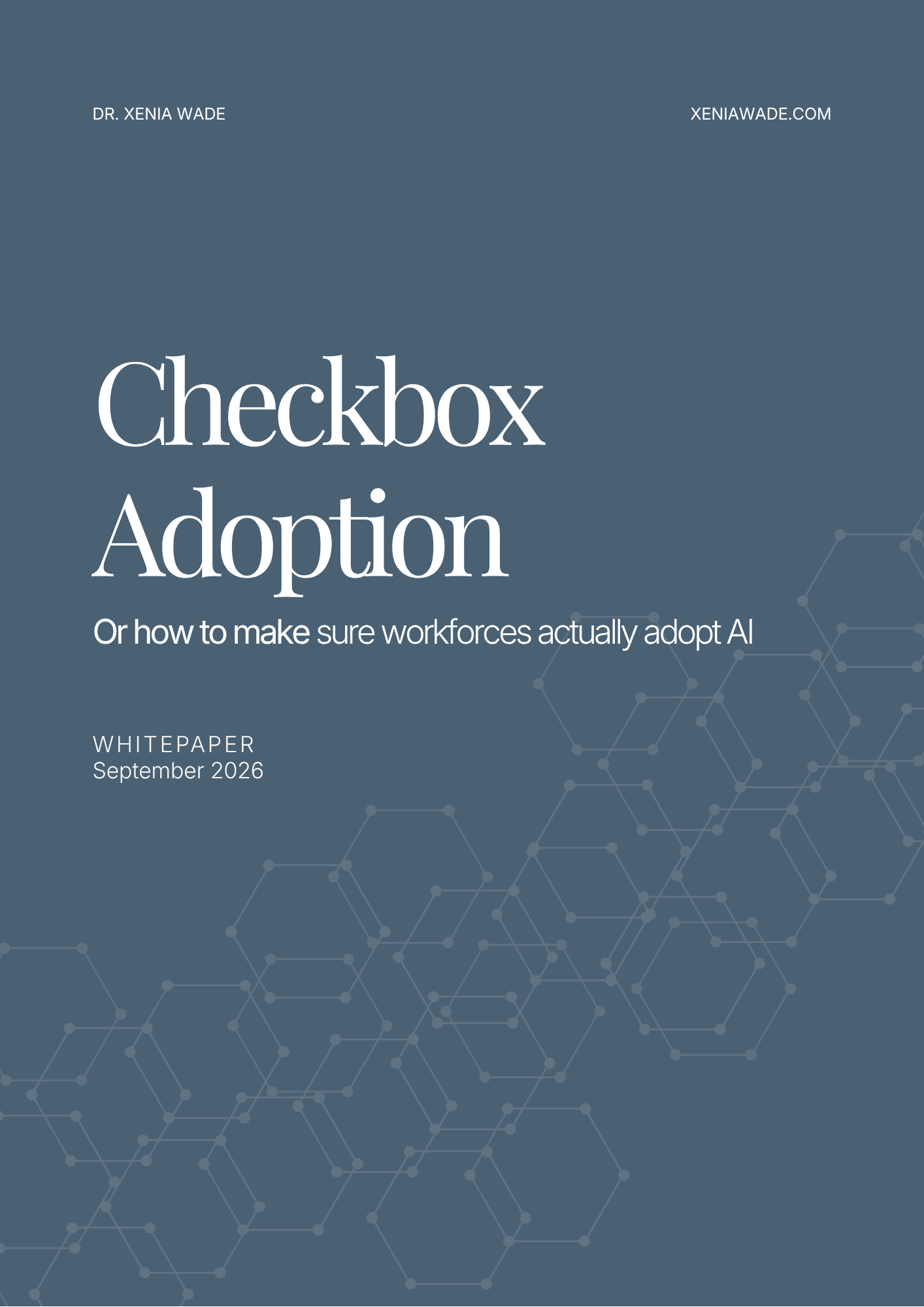
My whitepaper, Checkbox Adoption, asks one question: why do AI rollouts stall when the technology works and leadership is committed?
I interviewed 14 senior transformation and technology leaders across five countries and ten sectors, in organizations from 40 to over 100,000 employees. The pattern I found I call Checkbox Adoption: licenses get bought, training gets delivered, usage gets measured, and the way people work stays largely the same.
The research points to five conditions that shape whether people adopt AI: Adaptability Mindset, Psychological Safety, Empowerment Orientation, Action Style and Adoption Capacity. Together they form the Organizational Adoption Profile, the framework I use to find what's getting in the way.
Selected talks & media
- Sep 2026LEXtern, Deutsche TelekomMehr als Prompting: Von Unsicherheit zu selbstbewusstem Umgang mit KI
- Aug 2026CNBC Make ItForcing Workers to Use AI Can Be Counterproductive
- Aug 2026Business InsiderHow to Use AI in Your Job Search, According to HR Pros
- Jun 2026Now to Next with Jason AverbookThe Human Side of AI: Trust, Fear, and Why Change Management Must Change
- May 2026Webinar with GRN ConsultingHow to Build an AI-Ready Workforce
- May 2026Yahoo FinanceWomen Push Back Against Mel Robbins' Advice to Use AI to Help Manage Finances
Background
- PhD, Management, Organisation & Human ResourcesUniversität Trier · Erasmus teaching residency, University of Warwick
- M.A. Economic SociologyUniversität Trier & Clark University, USA
- B.A. SociologyUniversität Trier & Universiteit Antwerpen, Belgium
PMP · Certified Scrum Master · ITIL
Earlier academic research
Published under my maiden name, Schmidt.
Selected publications- Determinants of role-incongruent knowledge transfer behavior of apprentices and trainers in the context of the German apprenticeship systemSchmidt, X., Muehlfeld, K., & Peter, A. (2022). German Journal of Human Resource Management, 36(4), 474–504.
- What's so special about intergenerational knowledge transfer? Identifying challenges of intergenerational knowledge transferSchmidt, X., & Muehlfeld, K. (2017). Management Revue, 28(4), 375–411.
- Motivationsfaktoren zur Teilnahme am intergenerationellen Wissenstransfer im Rahmen von MentoringprogrammenSchmidt, X., Ury, M., & Muehlfeld, K. (2017). In H. Surrey & V. Tiberius (Hrsg.), Die Zukunft des Personalmanagements 2025: Herausforderungen, Lösungsansätze und Gestaltungsoptionen (S. 109–116). Zürich: vdf Hochschulverlag.
- It's just a matter of perspective?Schmidt, X., & Muehlfeld, K. (2017). Academy of Management Proceedings, 2017(1), 16994. Annual Meeting, Atlanta.
- Conference paper on intergenerational knowledge transfer31st EIASM Workshop on Strategic Human Resource Management, Segovia, Spain, April 2016.
Tell me where
AI use is stuck.
30 minutes, no pitch deck. We look at what's happening, and you leave with a clear next step.
Book a 30-minute call