By Dr. Xenia Wade | The Human Side of AI at Work
88% of organisations now regularly use AI in at least one business function. Approximately one-third have begun scaling it across the enterprise. That’s McKinsey’s November 2025 State of AI survey of nearly 2,000 organisations. The gap it describes comes down to change management for AI adoption, and the blockers are consistent: workflow rigidity, operating model inertia, and the absence of the people-side infrastructure that turns a deployment into genuine change.
Most change management for AI adoption fails because it treats adoption as a deployment event rather than a human transformation. The result is what I call Checkbox Adoption: usage logged, training completed, dashboards green, and nothing about how people actually work has changed.
I’ve explored Checkbox Adoption in detail elsewhere. What I want to address here is the change management layer underneath it: the measures that actually improve AI adoption, and the ones that reliably don’t.
Why Standard Change Management for AI Adoption Falls Short
Traditional change management was designed for a different kind of change: a system implementation, a restructure or a process redesign. Those had a clear before and after. You could define the end state, train to it, communicate the timeline, and eventually call the project done.
AI adoption doesn’t close like that. It’s continuous and cumulative. The capabilities change, the use cases expand, and the emotional weight of it doesn’t lift just because the go-live date passed. People are reading headlines about 92 million jobs displaced by 2030 while also being handed a new AI tool and told to get on with it. The psychological stakes are categorically different from any previous enterprise technology rollout.
Microsoft’s 2026 Work Trend Index surveyed 20,000 AI-using knowledge workers across ten markets. Leaders were significantly more likely than employees to report feeling safe suggesting new ways of working with AI (81% vs. 67%), and that their managers create space for AI experimentation (78% vs. 59%). Leaders are driving adoption faster than their workforce can absorb it, and that gap is exactly where resistance takes hold.
This shows up as Silent Resistance: the quiet disengagement that never registers on an adoption dashboard because people are nodding along in town halls while going back to doing things the old way. And it shows up as AI Shame. Both of them are killing your return.
If people are quietly working against your rollout, the problem starts before training. The free field guide walks you through three moves to get adoption moving. → Get the field guide
The Measures That Actually Improve AI Adoption
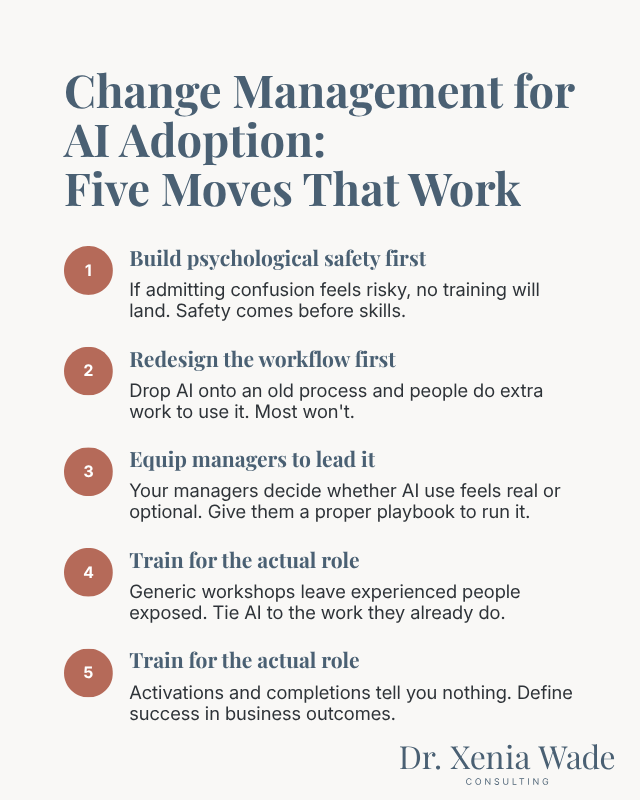
Make psychological safety a precondition
The most consistently skipped step in AI change programmes is the one that determines whether everything else can function.
A 2025 peer-reviewed study in Humanities and Social Sciences Communications traced the psychological consequences of AI adoption across 381 employees using a three-wave time-lagged design. The findings were direct: AI adoption significantly reduces psychological safety, and that reduction increases employee depression. When leaders demonstrate transparency and genuine concern through the transition, the damage to safety is significantly reduced. The research positions psychological safety as a measurable moderator of whether AI adoption causes harm or enables growth .
Psychological Safety is one of the five drivers in the Organisational Adoption Profile. When teams don’t feel safe enough to say ‘I don’t understand this,’ they can’t learn. When they can’t learn, they hide. And when they hide, your adoption data looks fine while genuine capability development quietly stalls.
What this requires in practice: leaders naming the fear directly in town halls and team conversations, before training launches. Acknowledging that the technology is changing what expertise looks like. Building explicit spaces, whether structured peer learning, Q&A sessions, or protected experimentation time, where confusion is a starting point rather than an embarrassment.
Redesign the workflow before you scale the tool
When AI sits alongside an unreformed process instead of inside it, employees have to do extra work to use it. Most of them won’t. The tool becomes shelfware, adoption numbers look flat, and leadership concludes the organisation is resistant.
McKinsey tested 25 adoption and scaling attributes and found that redesigning workflows has the single largest effect on an organisation’s ability to see EBIT impact from AI. Most organisations haven’t done it: only 21% of respondents whose organisations use gen AI say they have fundamentally redesigned at least some workflows.
The practical starting point is narrower than most leaders expect. Two or three workflows with clear pain points and measurable outcomes. Map what actually happens today. Redesign around AI, define where human review is required, and train to the redesigned workflow. Scale only after you have evidence from real users.
Equip managers to lead adoption
Executive communication launches AI programmes and manager behaviour sustains them.
Managers translate strategy into daily action. They model whether AI use is genuinely expected or theoretically encouraged. They respond to the first person who admits confusion, either with safety or with judgement. And they’re the first to see Silent Resistance building in a team before it shows up in any metric.
Microsoft’s People Science team, in a separate study of 1,800 workers, found that employees were 1.4 times more likely to be high-frequency users of agentic AI when their managers created psychological safety around experimentation. That’s a manager effect. Training alone can’t produce it.
Most AI change programmes give managers a communication cascade and little else. What they actually need is a practical playbook: how to introduce AI in team settings, how to handle scepticism without dismissing it, how to spot and address avoidance, and how to connect early wins to team confidence. That’s a specific capability that requires specific preparation.
Build training around the roles people already hold
When a 25-year-old who already uses AI daily and a 50-year-old with 25 years of expertise sit through the same prompt-engineering workshop, the experienced professional doesn’t leave feeling capable. They leave feeling exposed. Mandatory training without psychological safety underneath it surfaces the gap between where people are and where the programme expects them to be, and that gap converts directly into avoidance.
Role-based training changes the dynamic. It connects AI capability to the specific work the person already does. The finance analyst, the HR business partner, the operations manager: each of them needs to see AI applied to their actual workflow before they’ll engage with it in their own. Generic capability building can come later, once people have a personal entry point.
Measure the quality of adoption, and define it before go-live
Licence activation and training completion are activity metrics. They tell you that something happened. They don’t tell you whether anything changed.
Prosci’s Best Practices in Change Management research, compiled from 25 years of benchmarking and more than 10,800 practitioners across 101 countries, is direct: projects with excellent change management are seven times more likely to meet their objectives than those with poor change management. The differentiator isn’t the tool or the budget. It’s whether the change programme was built to change behaviour or to document compliance.
This is the Checkbox Adoption problem in its clearest form. The measurement fix is to define adoption success in business outcomes before the programme launches: AI integrated into discretionary tasks as well as required ones, or cycle time in a target workflow decreasing by a measurable amount. Define that target before go-live. That’s how you know whether the change management actually worked. I’ve described the full pattern in the Checkbox Adoption article.
The Sequence of AI Adoption Measures Matters
Most organisations run AI adoption in this order: tools deployed, training scheduled, governance built once something goes wrong, culture addressed once the numbers disappoint.
The sequence that produces genuine adoption is the reverse. Safety built before tools go live. Role-specific entry points before generic capability programmes. Workflows redesigned before people are asked to change how they work. Governance launched as an enabler from day one. And measurement tied to business outcomes from the start.
McKinsey’s November 2025 State of AI research is unambiguous on where the gap sits. Only 39% of organisations report EBIT impact at the enterprise level. The transition from pilots to scaled impact is still a work in progress at most organisations. That’s a change management problem. And it has a change management solution.
Your AI rollout isn’t failing because of the technology. Get the free field guide: three moves, grounded in behavioural science, that you can start this week. → Get the free field guide
Frequently Asked Questions About Change Management for AI Adoption
Change management for AI adoption is the structured approach to preparing people, culture, and workflows for AI integration. It goes beyond communication plans and training schedules to address the psychological, behavioural, and cultural conditions that determine whether employees actually change how they work. Without it, organisations typically get Checkbox Adoption: compliance that shows up in dashboards while genuine capability development remains absent.
Because the tools aren’t the bottleneck. McKinsey’s November 2025 State of AI research found that nearly two-thirds of organisations remain in pilot or experimentation mode despite 88% reporting AI use. The most consistent blockers to scaling are workflow rigidity, operating model inertia, and the absence of measurable accountability for people-side outcomes.
Building psychological safety before rolling out AI capability. A 2025 study by Kim, Kim and Lee found that AI adoption significantly erodes psychological safety, and that erosion directly increases employee depression and disengagement. When people don’t feel safe to admit confusion, they can’t learn. Training a workforce that isn’t safe enough to say ‘I don’t understand this’ produces compliance and nothing more.
Checkbox Adoption is the gap between the metrics of adoption and the substance of it. Licences are activated. Training is completed. Dashboards look healthy. And nothing about how people actually work has changed. It’s the most common failure mode in AI rollouts because it’s invisible from the outside. A full account of the pattern is in my dedicated article on Checkbox Adoption.
Through behavioural and outcome-based metrics rather than activity metrics. Licence activation and training completion tell you that something happened. Meaningful measures include actual integration of AI into discretionary tasks, changes in cycle time or quality in target workflows, employee-reported confidence and psychological safety around AI use, and business outcomes tied to the workflows where AI was deployed.
The Organisational Adoption Profile (OAP) is a readiness diagnostic framework that measures five drivers of AI adoption: Psychological Safety, Adaptability Mindset, Empowerment Orientation, Action Style, and Adoption Capacity. It’s the framework underpinning the free AI Adoption Readiness Diagnostic at xeniawade.com, which shows CHROs and People & Culture leaders where adoption barriers are concentrated and which drivers to address first.
Dr. Xenia Wade specializes in Human-Centered AI Change, helping organizations build the emotional and cultural readiness their people need to actually adopt AI. With a PhD in Human Resource Management and experience across enterprise-scale organizational transformations, she focuses on the human side of AI at work, the fears, the identity shifts, and the invisible barriers that no productivity dashboard can capture.
Follow Dr. Xenia Wade on LinkedIn and Substack.
Related concepts: Identity Drift · Silent Resistance · AI Shame · Emotional Carrying Capacity · Checkbox Adoption
Sources
- McKinsey & Company. (2025, November 5). The State of AI in 2025: Agents, Innovation, and Transformation. Survey of 1,993 participants across approximately 105 countries, conducted June 25 to July 29, 2025. mckinsey.com/capabilities/quantumblack/our-insights/the-state-of-ai
- McKinsey & Company. (2025, March 12). The State of AI: How Organizations Are Rewiring to Capture Value. Analysis of 25 organisational attributes against reported EBIT impact from gen AI. mckinsey.com/capabilities/quantumblack/our-insights/the-state-of-ai-how-organizations-are-rewiring-to-capture-value
- Microsoft Corporation. (2026, May 5). Work Trend Index Annual Report 2026: Agents, Human Agency, and the Opportunity for Every Organization. Survey of 20,000 AI-using knowledge workers across 10 markets, fielded February 18 to April 20, 2026, plus a separate Microsoft People Science survey of 1,800 employees globally. microsoft.com/en-us/worklab/work-trend-index/agents-human-agency-and-the-opportunity-for-every-organization
- Kim, B.J., Kim, M.J. & Lee, J. (2025). The dark side of artificial intelligence adoption: Linking AI adoption to employee depression via psychological safety and ethical leadership. Humanities and Social Sciences Communications, 12, Article 704.
- Prosci. (2023). Best Practices in Change Management, 12th Edition. Benchmarking research from more than 10,800 practitioners across 101 countries, compiled over 25 years. prosci.com/blog/change-management-best-practices