By Dr. Xenia Wade | The Human Side of AI at Work
Working with AI agents can genuinely change what your team is capable of. Done well, it’s not close: people get more creative, faster, freer to focus on the parts of the job only they can do.
But a lot of rollouts stop short of that. The tools are in, the training happened, usage is climbing. And still, something feels off. Reviews are getting waved through. When an agent gets something wrong, nobody quite owns it.
If that sounds familiar, you’re not behind. You’re seeing the part of the rollout nobody measured. The research on this is now clear enough to act on. And it points to one uncomfortable truth: how your people work with agents matters far more than which agents they work with.
Working with AI agents: the rollout happened, the collaboration didn’t
Agents are now in every industry. Microsoft’s 2026 Work Trend Index, built on a survey of 20,000 AI users across 10 countries, found that the teams getting real value from agents do a few things differently. They work out together where an agent fits, 63% of them against 32% of other teams. They share tips and mistakes openly, 61% against 36%. And they actually talk about what good AI-assisted work looks like, 54% against 29%.
Read that list again. None of it is about the technology.
Most organisations did the opposite. They bought the agents, activated the licences, ticked the training box, and called it adoption. I call that Checkbox Adoption: everything is deployed, and nothing has actually changed in how people work. The licences are live. The collaboration never started.
There’s a second shift hiding underneath, and it’s easy to miss. Your people aren’t only using agents any more. Agents are starting to direct them too. An agent that assigns work, flags exceptions, or decides what gets escalated is managing your team, whether you call it that or not. Research in the Academy of Management Annals shows these are two sides of the same coin. Humans manage with AI, and humans are managed by it. When people sense they’re being managed by something opaque that nobody answers for, trust drains fast.
Recognise the gap between your dashboards and your people? You don’t have to work out the human side alone. My free field guide shows you where collaboration with agents breaks, and what to do about it.
What working with AI agents looks like when it works
The strongest evidence points to one simple rule. Let the agent handle the repeatable, well-defined work. Keep the judgment with your people.
Nan Jia and colleagues tested this in a field experiment at a telemarketing company, published in the Academy of Management Journal in 2024. The AI took the routine part of the job: finding and qualifying sales leads. The employees kept the human part: persuading the customer. Creativity went up. Sales went up with it. People had more room for the thinking only they could do.
A 2026 study in Scientific Reports, led by Wakslak, sharpens the how. People worked under three conditions: no AI, passive use where they copied AI-generated content, or active collaboration where they drafted first and then used AI to refine. Active collaboration kept people’s confidence, ownership, and sense of meaning intact, and the quality matched working unaided. Passive copying did the opposite.
So the order matters. Think first. Then bring in the agent.
That’s it. That’s the core of good collaboration with agents. Everything else, the governance, the training, the workflow design, exists to protect that one principle.
What working with AI agents does to your people
Here’s the part that worries me, because it stays invisible until it’s expensive.
When people hand the thinking to the agent instead of thinking with it, they get a short-term boost and a long-term bill. Wu and colleagues showed this across four experiments with more than 3,500 people, published in Scientific Reports in 2025. Working with generative AI improved immediate output. The improvement didn’t carry over when people later worked alone. Worse, they came out of it less motivated and more bored than people who’d worked without the AI.
The Wakslak study found the same shape. Passive AI use ate away at people’s confidence in their own ability, their sense of ownership, and the meaning they found in the work. And the dip lasted even after they went back to working without it.
The Jia experiment found the gains were skill-biased. Higher-skilled employees got more creative and more energised. Lower-skilled employees improved only a little and felt worse. Drop agents into a team without support, and you can widen the gap between your strongest and weakest people while telling yourself you’ve levelled the playing field.
And when that gap goes unspoken, people don’t raise their hand. They go quiet. They finish the agent training, nod in the all-hands, and keep their doubts to themselves. That’s Silent Resistance, and it’s the most reliable sign the collaboration is failing while every adoption metric says it’s working.
Working with AI agents doesn’t mean hiring them
One framing choice does more quiet damage than almost anything else. Treating the agent as an employee. A name, a job title, a manager, a slot on the org chart. It feels friendly, and it signals ambition. A randomised experiment published in Harvard Business Review in May 2026 shows it backfires.
They gave 1,261 managers in HR and finance the same flawed documents to review. The only thing that changed was who supposedly wrote them: an AI tool, a human colleague, or an “AI employee”. Among managers whose organisations already list agents on the org chart, that one label changed everything.
- Accountability blurred. Framed as an employee, the personal responsibility managers took for the work fell by 9 percentage points, and the blame they pinned on the AI rose by 8. One participant described colleagues narrating errors as “Kevin’s mistake”, quietly shifting responsibility onto a system that can’t hold any.
- Review quality dropped. Managers reviewing an “AI employee’s” work caught 18% fewer errors than those reviewing identical output from an AI tool. A budget that claimed savings while the spreadsheet showed a rise. An entry-level job advert demanding ten years’ experience. The employee label lowered their guard.
- Escalation climbed. Requests to pass work up for another review rose 44%, often replacing the reviewer’s own careful checking rather than adding to it.
None of this means the collaboration itself is the problem. The Jia and Wakslak studies above used the same agents, doing similarly demanding work, and produced real gains. The difference was entirely in the framing and the process, not the technology.And the framing didn’t even buy what leaders hoped for. It did nothing for adoption. What it raised was anxiety: managers in those organisations were 13% more likely to feel unsure about their own professional identity, more worried about job security, and less trusting of how AI would be used. One participant put it plainly: if you want people to feel replaceable, put the AI on the org chart.
Be honest about what an agent is: software that needs a human accountable for it. Name it if that helps people work with it. Just stop short of pretending it can carry responsibility it can’t hold and recognize that because it can’t, it actually demands more disciplined governance and accountability infrastructure than a human colleague ever would
Worried the “AI employee” idea has already taken root in your organisation? The field guide walks you through the accountability questions to ask before it costs you, in plain language you can take into your next leadership meeting.
How to get working with AI agents right
There’s reason to be deliberate about how you bring agents in. You don’t fix this with another tool. You fix it with how you design the work around the tool.
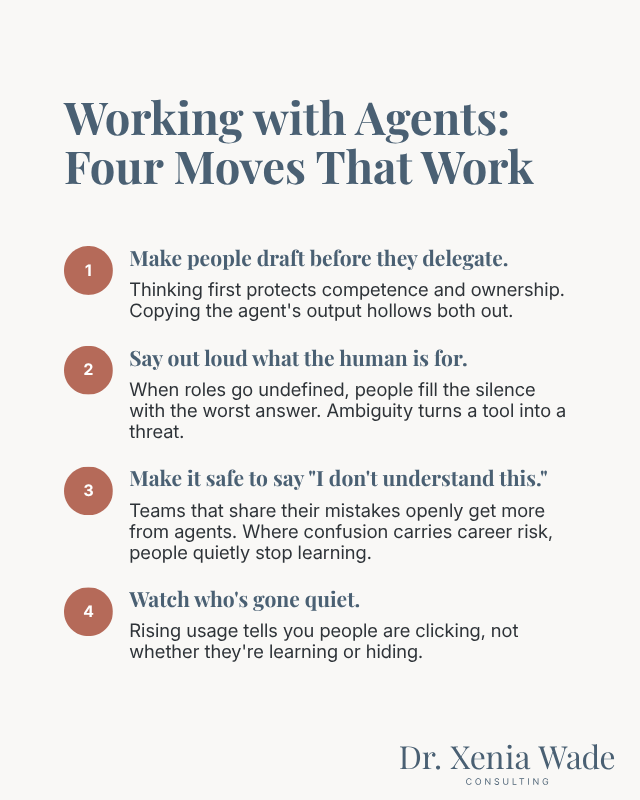
- Make people draft before they delegate. Thinking first and refining with the agent protects competence, ownership, and the meaning people find in the work. Copying its output hollows all three out. The loss lasts after the agent is gone.
- Say out loud what the human is for. When roles go undefined, people fill the silence with the worst answer. Name the judgment and the calls that stay with your people. Name who owns the agent’s output. Ambiguity turns a tool into a threat.
- Make it safe to say “I don’t understand this.” Teams that share their mistakes openly get more from agents. Where admitting confusion carries career risk, people escalate work they should have checked themselves, and quietly stop learning.
- Watch who’s gone quiet. Agents don’t lift everyone equally. Your strongest people get stronger. Your most exposed people improve less, feel worse, and say nothing. Rising usage tells you people are clicking. It doesn’t tell you whether they’re learning, growing, or hiding.
None of this shows up in a licence report. It’s the psychological and cultural readiness underneath the rollout, and it’s exactly what my Organisational Adoption Profile measures: five drivers, from psychological safety to adoption capacity, that decide whether working with agents builds your people up or hollows them out.
The organisations getting this right aren’t the ones with the best agents. They’re the ones that treated the human side of the collaboration with the same rigour as the technical rollout. Agents can genuinely lift what a team produces, when the collaboration around them is designed as carefully as the technology itself. That’s a design choice, and it’s still yours to make.
Find out where your people actually are, not where your rollout plan says they are. The free field guide gives you the questions, the warning signs, and the first steps. It’s the fastest way to see what your dashboards can’t.
Frequently Asked Questions About Change Management for AI Adoption
Working with an AI agent means sharing a task with software that can act on your behalf, not just answer questions. The agent takes the repeatable, well-defined part of the work. A person directs it, checks it, and stays responsible for the result. The quality of the partnership depends on how the work is divided, far more than on how clever the agent is.
It depends on how they use it. A 2025 study in Scientific Reports by Wu and colleagues found that working with generative AI improved people’s immediate output but left them less motivated and more bored, and the gains vanished when they later worked alone. People who let the agent do the thinking lose confidence, ownership, and skill over time. People who think first and refine with the agent keep all three.
Passive use means copying what the agent produces. Active collaboration means doing your own thinking first, then using the agent to refine it. A 2026 Scientific Reports study led by Cheryl Wakslak found passive use eroded people’s confidence, ownership, and sense of meaning, while active collaboration preserved all three and matched the quality of unaided work.
No. A 2026 Harvard Business Review experiment with 1,261 managers, led by Matthew Kropp, found that framing AI as an employee reduced the personal accountability people took for its work, cut the errors they caught by 18%, raised unnecessary escalation by 44%, and made people more anxious about their own roles. It did nothing for adoption. Treat agents as software with a named human owner.
No. A 2024 field experiment in the Academy of Management Journal found the benefits were skill-biased. Higher-skilled employees became more creative and more energised. Lower-skilled employees improved less and felt worse at work. Without deliberate support, agents widen the gap between your strongest and weakest performers rather than closing it.
Name a human owner for every agent’s output. Set decision rights: what the agent may do alone, what needs sign-off, and what triggers a review. Document the handovers between person and agent. Microsoft’s 2026 Work Trend Index found the highest-performing teams document agent workflows, human handoffs, and quality standards far more often than their peers. Accountability is what turns automation into trust.
Dr. Xenia Wade specializes in Human-Centered AI Change, helping organizations build the emotional and cultural readiness their people need to actually adopt AI. With a PhD in Human Resource Management and experience across enterprise-scale organizational transformations, she focuses on the human side of AI at work, the fears, the identity shifts, and the invisible barriers that no productivity dashboard can capture.
Sources
- Microsoft. (2026). 2026 Work Trend Index: Agents, Human Agency, and the Opportunity for Every Organisation.
- Hillebrand, L., Raisch, S. & Schad, J. (2025). Managing with Artificial Intelligence: An Integrative Framework. Academy of Management Annals.
- Jia, N., Luo, X., Fang, Z. & Liao, C. (2024). When and How Artificial Intelligence Augments Employee Creativity. Academy of Management Journal.
- Wu, S., Liu, Y., Ruan, M., Chen, S. & Xie, X.Y. (2025). Human-generative AI collaboration enhances task performance but undermines humans’ intrinsic motivation. Scientific Reports.
- Wakslak, C.J. et al. (2026). Relying on AI at work reduces self-efficacy, ownership, and meaning while active collaboration mitigates the effects. Scientific Reports.
- Kropp, M., Bedard, J., Wiles, E., Hsu, M. & Krayer, L. (2026, 6 May). Research: Why You Shouldn’t Treat AI Agents Like Employees. Harvard Business Review.