By Dr. Xenia Wade | The Human Side of AI at Work
68% of enterprises fail to achieve their desired ROI on digital transformation. Most cite change resistance as the primary reason, according to Everest Group, 2021.
That’s not a technology problem because the technology was deployed. The people just didn’t change how they work and then the return never arrived.
The change management ROI question most leaders ask is: what will it cost? The more expensive question is the one they don’t ask. What does it cost when we skip it?
Is your organisation actually ready for AI, or just pretending to be? The AI Adoption Readiness Scan measures what your dashboards can’t: the emotional and cultural barriers silently stalling your transformation. → Take the free AI Adoption Readiness Diagnostic
What Change Management ROI Actually Means
There’s no universal dollar figure for change management return on investment. Anyone who gives you one with confidence is confusing confidence with evidence.
The return depends on three things: the scale of the transformation, the cost of the change programme, and how much of the expected project value depends on employees actually changing how they work. That last variable is the one most organisations never calculate before they launch.
Tim Creasey at Prosci has the most useful reframe here. Stop asking “what is the ROI of change management?” and start asking: what percentage of our project benefits depends on employee adoption? For a hardware upgrade, that adoption-dependent portion is relatively small. For an AI deployment where every knowledge worker has to do their job differently, it’s the majority. That portion is exactly what a well-run change programme protects (Creasey, 2018).
The Everest Group found that 68% of enterprises fail to achieve their desired ROI on digital transformation, and most cite change resistance as the primary obstacle (Everest Group, 2021). Industry analyst data from a practitioner survey, not a peer-reviewed study. But the pattern holds against the academic evidence.
Reis and Melão’s (2023) meta-review of the digital transformation literature identifies poor management support, weak communication, and unclear objectives as the primary reasons transformation programmes underperform, and frames these as change management failures, not technology ones. Hanelt, Bohnsack, Marz, and Antunes Marante’s systematic review of 279 studies reaches the same conclusion: transformation success depends on organisational readiness, leadership alignment, and stakeholder communication working as integrated priorities (Hanelt et al., 2021).
The ROI case doesn’t rest on a precise figure. It rests on a consistent pattern. Organisations that manage the human side of transformation well are more likely to realise their projected return. The ones that treat it as a communications task are more likely to spend time explaining why the numbers didn’t land.
The Cost of Poor Change Management
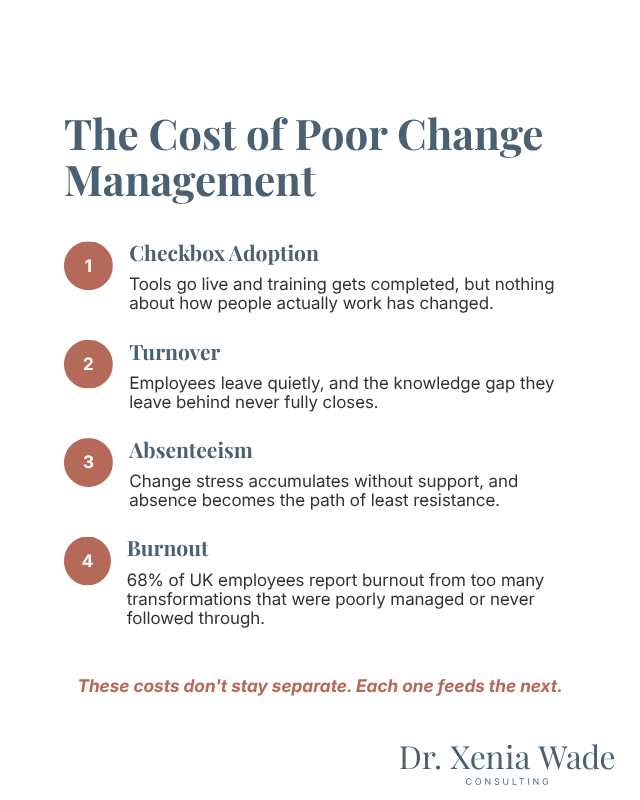
When change management is skipped or underfunded, the costs don’t stay in one place. They spread across four areas that compound each other.
Checkbox Adoption
The most common failure mode in AI rollouts has a name. I call it Checkbox Adoption.
Licences activated. Training completed. Dashboard green. And nothing about how people actually work has changed.
Employees aren’t being cynical. Minimal compliance is a rational response to change that’s been announced rather than managed. When people have no genuine involvement in a transition that directly affects their work, doing the minimum is the logical path.
Stouten, Rousseau, and De Cremer’s (2018) review of organisational change research in the Academy of Management Annals is direct on what drives implementation success: clear communication, leader involvement, and genuine employee participation. Remove those and you can end up with quiet avoidance. Tools that technically get used and functionally get ignored.
Turnover
Change resistance shows up in exit interviews before it shows up in adoption metrics.
When transitions are unclear, employees feel sidelined from decisions that affect their work, or the change programme adds pressure without adding support, people leave. Quietly, to a role where they know what’s expected of them.
That cost never gets traced back to the rollout. It shows up in recruiting budgets and onboarding timelines. In a knowledge gap no new hire fully closes. In an organisation running its next change programme with fewer of the people who understood the last one.
Hanelt and colleagues are direct on the mechanism: organisations that treat people as a variable in a technology project consistently fare worse than those that treat the human transition as the actual project (Hanelt et al., 2021).
Absenteeism
Safe Work Australia’s large-scale research on psychosocial safety climate found that improving low psychosocial safety could lead to a 43% reduction in sickness absence (Safe Work Australia, 2016). A government-commissioned workforce survey, directional rather than a controlled trial, but consistent with what the organisational psychology literature predicts. Low psychological safety and high absenteeism track together.
Therefore, absenteeism during a poorly managed transformation can be people hitting their limit. I call this an Emotional Carrying Capacity crisis. Every organisation has a ceiling for how much change pressure people can absorb before the cost starts showing up in their attendance. Badly managed change drops that ceiling fast.
Burnout
When roles shift without support, workloads spike to compensate for underused tools, and people are asked to adapt faster than they’re being helped to adapt, the outcome is predictable. The same Safe Work Australia research found that low psychosocial safety is associated with a 72% increase in presenteeism: employees physically present and cognitively absent (Safe Work Australia, 2016).
Emergn’s 2024 workforce survey adds the retention dimension. Nearly 60% of employees reported burnout from too many transformations, with the UK figure reaching 68%. More than half had considered leaving their jobs because of it.
Where is Checkbox Adoption hiding in your organisation? The AI Adoption Readiness Diagnostic measures five readiness drivers, including Adoption Capacity and Psychological Safety, so you can see what’s actually blocking use.
Why Most AI Change Programmes Fail Before They Start
“We did the training. We sent the comms. We ran the workshops.”
The problem is that a communication plan and a training schedule are the visible surface of change management but they’re not the substance of it.
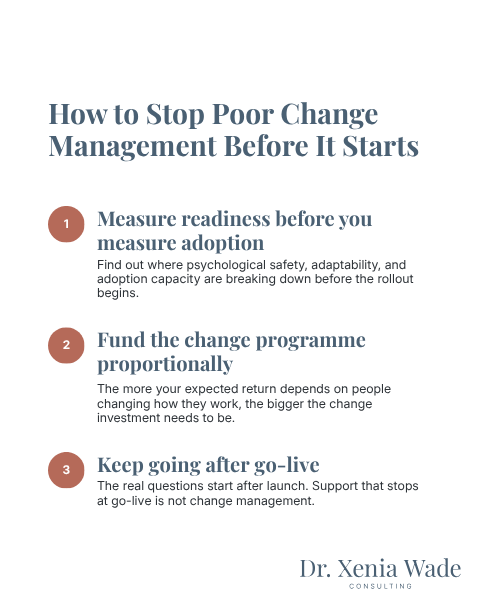
The substance is: leadership staying present through the adoption curve, not just the launch event. Communication that’s ongoing and two-way, not a series of announcements. Employees having genuine input into how the change is shaped, not just notification that it’s happening. Support that continues past go-live, when the real questions start.
Creasey’s framework makes the practical implication clear: resource the change programme in proportion to the percentage of project benefits that depend on people changing how they work (Creasey, 2018). When that percentage is high, which it usually is in AI deployments, treating change management as a line item you trim at the end is how you end up explaining the variance.
When 68% of enterprises cite change resistance as the reason they missed their projected return, that variance isn’t bad luck. It’s the predictable result of funding the technology and underfunding the transition.
How to Measure AI Change Readiness Before the ROI Problem Arrives
Adoption metrics tell you what happened. Readiness measures tell you what’s likely to happen. Most organisations track the former and skip the latter entirely.
When I work with organisations on AI adoption, I use the Organisational Adoption Profile framework to diagnose where readiness is actually breaking down. The OAP measures five drivers: Psychological Safety, Adaptability Mindset, Empowerment Orientation, Action Style, and Adoption Capacity.
The deficits that produce Checkbox Adoption, turnover, absenteeism, and burnout are almost always visible in the OAP before the rollout begins. Low Psychological Safety creates the silence around confusion that becomes AI Shame, the private embarrassment that stops people admitting they don’t understand tools they’re supposed to be championing. Low Adaptability Mindset produces the rigidity that reads as resistance. Low Adoption Capacity produces compliance without commitment.
Measuring readiness before a rollout is how you find out where the change management investment needs to go before the losses are already compounding.
There’s no universal change management ROI figure. What there is, consistently across the evidence, is a gap between organisations that fund the human side of transformation properly and those that don’t. The gap shows up in adoption data, in retention numbers, and in the return on technology investments that were supposed to change how work gets done.
The question worth sitting with before your next AI rollout: what percentage of the expected return depends on your people actually changing how they work? That answer tells you what the change programme should cost.
Not where your dashboards say you are. Where your people actually are. The AI Adoption Readiness Diagnostic measures the psychological, cultural, and emotional readiness that determines whether your AI investment pays off or quietly stalls. → Take the free AI Adoption Readiness Diagnostic
Frequently Asked Questions About AI and Psychological Safety
Change management ROI is the return generated when you invest in helping employees actually adopt a new technology or process, rather than just deploying it. There’s no universal percentage. The figure depends on how much of your project’s expected value depends on people changing how they work. For AI deployments, that adoption-dependent portion is typically the majority of the projected return.
The Everest Group found that 68% of enterprises fail to achieve their desired ROI on digital transformation, and most cite change resistance as the primary obstacle (Everest Group, 2021). The technology deploys. The people don’t change how they work. The return stays on the slide deck.
The costs appear across four areas: Checkbox Adoption, voluntary turnover, absenteeism, and burnout. Safe Work Australia’s research links low psychosocial safety to a 43% increase in sickness absence and a 72% increase in presenteeism (Safe Work Australia, 2016). Emergn’s 2024 survey found nearly 60% of employees reporting burnout from poorly managed transformation programmes. None of these costs stays contained. Each one amplifies the others.
Checkbox Adoption is what happens when a rollout produces the metrics of adoption without the reality of it. Training completed. Licences activated. Nothing changed. It’s a predictable response to change that’s been announced rather than managed. Employees comply with the minimum requirement and quietly continue doing their jobs the old way.
Emotional Carrying Capacity describes the limit of how much change pressure a person or organisation can absorb before the psychological cost starts showing up in behaviour. In transformation programmes, it surfaces as absenteeism, disengagement, and quiet exits from employees who haven’t been adequately supported through the transition.
The Organisational Adoption Profile measures five drivers that determine whether employees will genuinely adopt new tools: Psychological Safety, Adaptability Mindset, Empowerment Orientation, Action Style, and Adoption Capacity. The free AI Adoption Readiness Diagnostic at xenia-tkdyfwlr.scoreapp.com is built on the OAP. It gives CHROs a read on where adoption barriers are concentrated before the rollout, not after.
Dr. Xenia Wade specializes in Human-Centered AI Change, helping organizations build the emotional and cultural readiness their people need to actually adopt AI. With a PhD in Human Resource Management and experience across enterprise-scale organizational transformations, she focuses on the human side of AI at work, the fears, the identity shifts, and the invisible barriers that no productivity dashboard can capture.
Follow Dr. Xenia Wade on LinkedIn and Substack.
Related concepts: Silent Resistance | Emotional Carrying Capacity | Identity Drift | AI Shame | Checkbox Adoption
Sources
- Everest Group. (2021). 68% of enterprises fail to achieve desired ROI on digital transformation and most cite change resistance as key obstacle. everestgrp.com
- Creasey, T. (2018, updated September 10, 2025). Rethinking the ROI of change management. Prosci. prosci.com/blog/roi-change-management
- Stouten, J., Rousseau, D. M., & De Cremer, D. (2018). Successful organisational change: Integrating the management practice and scholarly literatures. Academy of Management Annals, 12(2). journals.aom.org
- Reis, J., & Melão, N. (2023). Digital transformation: A meta-review and guidelines for future research. Heliyon, 9(1). pmc.ncbi.nlm.nih.gov
- Hanelt, A., Bohnsack, R., Marz, D., & Antunes Marante, C. (2021). A systematic review of the literature on digital transformation: Insights and implications for strategy and organisational change. Journal of Management Studies, 58(5). onlinelibrary.wiley.com
- Emergn. (2024). Transformation fatigue: Employees leaving jobs due to frequent and failed transformations. emergn.com
- Safe Work Australia. (2016). Psychosocial safety climate and better productivity in Australian workplaces: Costs, productivity, presenteeism, absenteeism. safeworkaustralia.gov.au