By Dr. Xenia Wade | The Human Side of AI at Work
Generational differences in AI adoption at work have never been more visible than this headline: forty-four percent of Gen Z workers admit to actively sabotaging their company’s AI rollout.
My first instinct was to push back. I wrote my PhD on intergenerational knowledge transfer, including generational differences in AI adoption at work. I’ve watched generational generalisations cause as much confusion as clarity. But it kept me thinking.
The sabotage isn’t random. It isn’t technophobia. And it isn’t only a Gen Z problem.
But it’s showing up most visibly in Gen Z because they have a lot to lose.
The Data Behind Generational AI Adoption and Sabotage
In April 2026, Writer and Workplace Intelligence published findings from a survey of 2,400 knowledge workers across the U.S., U.K., and Europe, including 1,200 C-suite executives. 29% of employees overall admit to sabotaging their company’s AI strategy. Among Gen Z, that jumps to 44%.
The behaviour ranges from entering proprietary data into public AI tools to refusing approved systems to refusal to become AI-proficient.
And here’s the tension, while 70% of employees use AI daily, many are quietly working against their own company’s strategy. The same people who find AI useful are sabotaging it at work. That’s the core tension in generational differences in AI adoption at work, and it’s a signal worth understanding.
Generational Differences in AI Adoption at Work
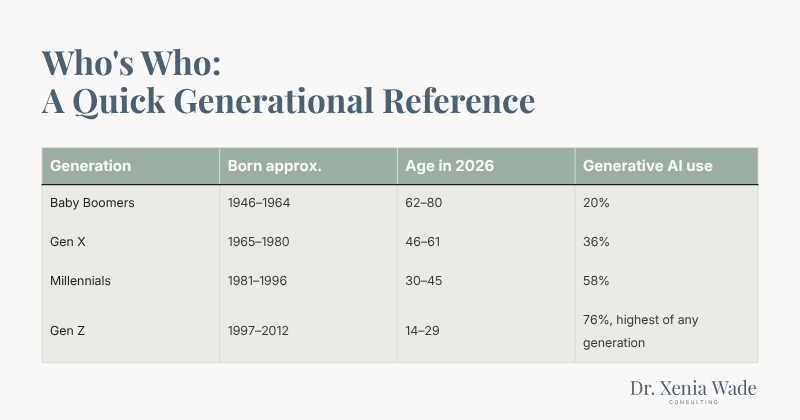
These labels get used loosely. Here’s how most workplace research defines them, alongside current AI tool use rates from a 2025 Deloitte survey.
Gen Alpha (born 2013 onwards) are just beginning to enter the workforce. They’re not yet in most workplace AI research, but they’re coming.
Why Gen Z Shows the Sharpest Generational Differences in AI Adoption
Gen Z leads in generative AI use overall. But in depth of workplace-specific use, millennials often outpace them. Gen Z experiments more and they’re not afraid of the technology. The root cause is more specific than that.
For Gen Z, AI is often a competitor that may have already taken their first job. That asymmetry of exposure explains most of the behavioural differences we’re seeing.
Dr. Xenia Wade · The Human Side of AI at Work
Gen Z entered the workforce as AI was automating the roles they were supposed to start in. Entry-level hiring at major tech companies has dropped more than 50% over three years, according to SignalFire data reported by Rest of World. LinkedIn, Indeed, and Eures recorded a 35% decline in junior tech positions across major EU countries in 2024 alone.
And the job market is only part of it. On top of job insecurity, Gen Z came of age through multiple serious disruptions: the pandemic, remote schooling, economic instability, and now an AI wave that arrived before they’d had a chance to build a career foundation. That accumulation matters. It shapes how uncertainty feels, and how much of it you can absorb before it becomes resistance.
A 22-year-old watching their first job category disappear isn’t being dramatic. They’re reading the room accurately. No amount of “AI will create new jobs” messaging lands when you can’t get your first one.
Generational Differences in AI Adoption: Generation or Age?
This is a question at the heart of generational differences in AI adoption at work, and one I spent years on in my PhD research.
There’s evidence in both directions. Some studies find that the differences we see across generations persist even when you control for age and career stage, which suggests there might be something real about shared formative experiences. Gen Z growing up through Covid, economic instability, and rapid digital change is a genuine cohort experience, not just a life-stage effect. But the more striking finding is that when you account for career stage and role type, the generational signal largely disappears. It’s more of a life-stage difference than a cohort effect.
My own work on intergenerational knowledge transfer found that what looks like a generational pattern is often better explained by the age difference and also where someone sits in their career. For example, older workers bring deeper contextual judgment due to more experience (Schmidt & Muehlfeld, 2017).
What we’re seeing in the Gen Z sabotage data is most likely several effects at once: career stage, a genuinely disruptive formative context, and a period where AI is right now eliminating the roles they were supposed to start in. The research doesn’t let us cleanly separate these. Anyone who tells you it’s purely a generation thing is oversimplifying.
Dr. Xenia Wade · The Human Side of AI at Work
The practical implication: “what generation are they?” is a less useful question than “what’s their relationship to career risk, and do they trust how this is being introduced?”
My research also points toward something directly relevant here: knowledge doesn’t only flow from older to younger workers; it goes both ways. The types of knowledge exchanged differ, as do the factors impacting the transfer. Applying these findings to an AI rollout, younger employees often bring practical tool fluency, while older employees provide the institutional and social context that determines whether those tools are used effectively. When adoption is structured as a one-way training cascade, both directions of that exchange are lost.
What the Sabotage Is Actually Communicating
The word makes it sound more calculated than it usually is.
Of the workers who admitted to undermining AI strategy, 30% cited fear of job displacement. Another 26% said AI has diminished their value or creativity. These aren’t the same problem (Writer & Workplace Intelligence, 2026).
They are experiencing fear of becoming obsolete, and also likely some type of Identity Drift. It’s the experience of watching the capabilities you built your career on become automatable before you’ve had the chance to build the judgment and seniority that would make you harder to replace.
The workers most afraid of being automated are engaging in the behaviour most likely to get them cut. That’s the Silent Resistance loop: anxiety drives avoidance, avoidance creates a performance gap, the gap increases the very risk they were trying to avoid.
→ Get the free field guide
Generational Differences in AI Adoption Affect Every Age Group
The mistake, when looking at generational differences in AI adoption at work, is to focus on the generation and miss the mechanism.
The mechanism is psychological safety, trust in leadership, and perceived fairness of the rollout. Those dynamics play out differently across generations and career stages, but they affect everyone.
A 2025 peer-reviewed study in Humanities and Social Sciences Communications traced the psychological consequences of AI adoption across 381 employees. The findings: AI adoption erodes psychological safety, which in turn increases employee depression. When leaders show transparency and genuine concern during the transition, the negative effect is significantly reduced.
The WEF’s Future of Jobs Report 2025 found 39% of existing workplace skills will be disrupted within five years. That applies to a 45-year-old just as much as a 25-year-old. Some might quietly avoid the tools, smile in the all-hands, and go home and worry. That’s Silent Resistance, and it’s often harder to see and more costly in the long run.
Each generation is experiencing the same transformation through a different lens. The intervention that works for a 24-year-old facing a disappearing career ladder is not the same one that works for a 52-year-old whose hard-won expertise is being automated. But the underlying need is the same: to feel that this change isn’t being done to them.
Dr. Xenia Wade · The Human Side of AI at Work
What Actually Helps With Generational Differences in AI Adoption at Work
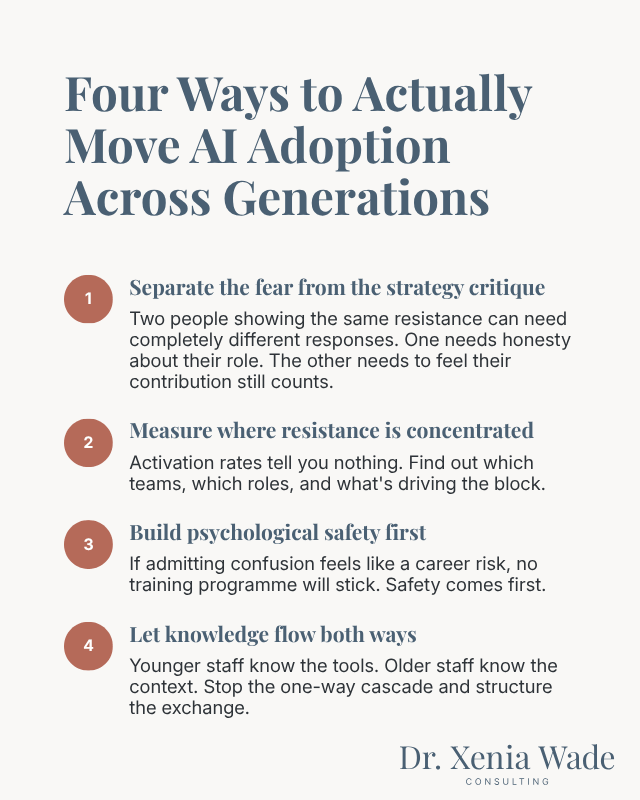
1. Separate the fear from the strategy critique
The 30% resisting out of job fear and the 26% who feel AI has diminished their value need different responses. One needs honesty about what’s changing in their role. The other needs to feel that AI is making their contribution more visible, not less. Treating them as one problem fails both groups.
2. Measure where resistance is concentrated
Activation rates tell you nothing useful. The Organisational Adoption Profile measures five readiness drivers (Psychological Safety, Adaptability Mindset, Empowerment Orientation, Action Style, and Adoption Capacity) at the team and role level, so you can see where adoption is actually stalling and why.
3. Build psychological safety before training
Kim, Kim & Lee (2025) show the mechanism: when AI adoption outpaces psychological safety, depression might follow. People need to feel that admitting confusion and making mistakes is safe before they’ll genuinely engage with learning new tools. Training in a low-safety environment doesn’t stick. You need to build psychological safety first.
4. Design for knowledge exchange, not just training cascade
Younger workers often hold tool fluency. Older workers hold institutional context and risk judgment. An adoption strategy that only trains individuals, rather than creating structured conditions for these different kinds of knowledge to meet, leaves significant value on the table.
If people are quietly working against your rollout, the problem starts before training.
The free field guide walks you through three moves to get adoption moving.
→ Get the field guide
Frequently Asked Questions About Generational Differences in AI Adoption at Work
In 2026, four main generations are active at work. Baby Boomers (born 1946–1964, now 62–80) are at or near retirement but many remain employed. Gen X (born 1965–1980, now 46–61) occupy most senior and mid-level management roles. Millennials (born 1981–1996, now 30–45) are the largest working cohort. Gen Z (born 1997–2012, now 14–29) are still building early-career foundations. Gen Alpha (born 2013 onwards) are just beginning to enter the workforce.
Some studies find generational differences hold even when controlling for age and career stage, suggesting that shared formative experiences shape something real. But most studies find that career stage and role type largely explain the differences, without needing a generational explanation at all.
Two distinct drivers show up in the data. Thirty percent cite fear of job displacement: they’re watching entry-level roles decline and don’t trust AI adoption won’t accelerate that. Another 26% say AI has diminished their sense of value or creativity: they’re not resisting AI, they’re resisting a process that makes them feel less, not more. These need different responses. Collapsing them into one training programme fails both groups.
For overall generative AI tool use, Gen Z leads at 76% (Deloitte, 2025). But for depth of workplace-specific use, millennials often show higher adoption. Gen Z experiments more broadly; millennials have had longer to integrate AI into established workflows. The difference is at least partly career stage, not just generation.
Fear of becoming obsolete describes the anxiety workers feel when AI begins automating the tasks their professional identity is built around. At the early-career stage it’s especially acute, because the ‘learn by doing’ entry-level work is precisely what AI agents are now handling. The result is avoidance and resistance that can stall adoption across the whole organisation.
Identity Drift describes the disorienting experience of watching your professional identity erode as the capabilities you’ve built your career on become automatable. For a Gen Z worker, this can happen before they’ve built the judgment and seniority that would buffer the disruption. For a mid-career professional, it hits differently: decades of expertise suddenly feeling less relevant. It’s an existential question about professional worth.
Understand the mechanism, not just the demographic. Fear of displacement and frustration with poor rollout strategy are two different problems. Measure readiness at the team and role level. Build psychological safety before training. And create conditions for knowledge to flow between generations in both directions, not just top-down. The question isn’t “what generation are they?” It’s “what’s their relationship to career risk, and do they trust how this is being introduced?”
Dr. Xenia Wade specializes in Human-Centered AI Change, helping organizations build the emotional and cultural readiness their people need to actually adopt AI. With a PhD in Human Resource Management and experience across enterprise-scale organizational transformations, she focuses on the human side of AI at work, the fears, the identity shifts, and the invisible barriers that no productivity dashboard can capture.
Follow Dr. Xenia Wade on LinkedIn and Substack.
Related concepts: Identity Drift · Silent Resistance · AI Shame · Emotional Carrying Capacity · Checkbox Adoption
Sources
- Writer & Workplace Intelligence. (2026). AI Adoption in the Enterprise. Survey of 2,400 knowledge workers across U.S., U.K., and Europe including 1,200 C-suite executives. writer.com
- Deloitte. (2025). Digital Consumer Trends: Gen AI adoption by generation. Standalone generative AI tool use rates by generation from Deloitte’s Digital Consumer Trends survey, fielded April–May 2025. deloitte.com
- Kim, B.J., Kim, M.J. & Lee, J. (2025). The dark side of artificial intelligence adoption: Linking AI adoption to employee depression via psychological safety and ethical leadership. Humanities and Social Sciences Communications.
- World Economic Forum. (2025). The Future of Jobs Report 2025. Fifth edition. weforum.org
- Rest of World. (2025, December 19). AI is wiping out entry-level tech jobs, leaving graduates stranded. Data from SignalFire State of Talent Report 2025. restofworld.org
- Schmidt, X. & Muehlfeld, K. What’s so special about intergenerational knowledge transfer? Identifying challenges of intergenerational knowledge transfer. Management Revue.